Three days ago, devotees from all over the world joyfully gathered to celebrate the 77th Vyasa Puja of His Holiness Jayapataka Swami Guru Maharaj, and with each passing year, it truly feels that the bliss, enthusiasm, and heartfelt glorification only continue to increase. This year’s sacred celebration took place over two beautiful days, beginning on the 28th of March with the Vyasa Puja Adhivas and continuing on the 29th of March with the grand Vyasa Puja Mahotsava. In Sridham Mayapur, this celebration always feels like a mini Gaura Purnima, as thousands and thousands of disciples, friends, godbrothers, and well-wishers come together in unity to glorify their beloved spiritual master. The atmosphere becomes filled with kirtan, prayers, and loving offerings, and one can feel a deep sense of gratitude in every heart.
His Holiness Jayapataka Swami Guru Maharaj is one of the senior disciples of Srila Prabhupada, the Founder-Acharya of ISKCON, and his entire life stands as an example of unwavering dedication to the mission of his spiritual master. From the early days of assisting Srila Prabhupada to helping develop Mayapur into the spiritual center it is today, Guru Maharaj has spent decades tirelessly traveling, preaching, guiding disciples, and inspiring countless souls toward Krishna consciousness. His compassion and determination have helped expand the mission of Srila Prabhupada worldwide, and his life continues to inspire thousands to remain steady in devotional service. For devotees, Vyasa Puja is not merely a celebration, it is a day to reflect deeply on the mercy received through the spiritual master and to offer heartfelt gratitude for his guidance.
In October 2008, Gurumaharaja suffered a massive stroke that caused bleeding in two areas of the brain, including the delicate brain stem. The situation was extremely critical, and doctors acknowledged that the chances of survival were very slim. Devotees around the world prayed intensely, knowing that his life was not his own, but meant for the service of his Guru and the mission of Lord Caitanya.
Yet even in those life-threatening moments, his consciousness remained fixed in devotional service. While lying in the hospital, unable to speak due to medical tubes and machines, he still showed his deep compassion by encouraging those around him to chant. Devotees recall that he was given a clicker so that he could continue his chanting, even when speech was not possible. This reveals the extraordinary depth of his attachment to the holy name, that even when the body was failing, his spiritual determination remained strong.
What is even more astonishing is that only four months after such a devastating stroke, he insisted on returning to Mayapur to attend the Gaura Purnima festival, something he had not missed for decades. Despite the intense rehabilitation required, including daily physiotherapy and medical supervision, his desire was always to return to preaching and serving. His focus was never on comfort, but always on fulfilling his responsibility to his Guru and disciples.
Over the years, Gurumaharaja has faced multiple serious health challenges, including severe infections, lung complications, and in 2018, a major kidney and liver transplant that required long hospitalization and recovery. Yet even during those difficult times, his spirit of devotion did not weaken. In fact, after long hospital stays where he was unable to complete his daily chanting, once he regained strength, he carefully made up the rounds he had missed, chanting hundreds of extra rounds until his vow was complete. Such determination is almost unimaginable for ordinary persons, yet for him it is simply part of his lifelong commitment to devotional service.
Every day, Gurumaharaja thinks about how to deliver his disciples and how to bring Krishna consciousness to the whole world. Even at the brink of death, in the hospital bed, surrounded by machines and doctors, his concern was not for his own suffering but for the spiritual benefit of others. He distributed Mahaprasad to doctors and inspired them to chant, turning even the hospital environment into a place of spiritual connection.
This is our Gurumaharaj, completely selfless, completely absorbed, and completely dedicated. His life is a living example of what it means to serve without hesitation, without complaint, and without pause. Even when the body is weak, his determination to preach remains strong. Even when health fails, his chanting continues. Even when facing unimaginable pain, his only desire is to carry out the instructions of his Guru.
To witness such dedication is both humbling and inspiring. It reminds us that spiritual life is not meant to be casual or convenient, but sincere and steady. Gurumaharaja’s example shows us that even in illness, even in weakness, even in the most uncertain moments of life, one can remain fixed in service.
The Vyasa Puja celebration began on the 28th of March with the Adhivas day, setting the devotional mood for the festival. The morning began with Srimad Bhagavatam class, followed by a yajna offered for Guru Maharaj’s continued health and preaching mission. Later in the day, devotees gathered for melodious bhajan kirtan, filling the temple with the vibration of the holy names. A special health update and preaching report was shared, inspiring everyone to hear about Guru Maharaj’s ongoing service and determination. In the evening, the Adhivas ceremony marked the formal beginning of the Vyasa Puja festivities, followed by a joyful cultural program where devotees expressed their love through music, drama, and devotional offerings.
The main Vyasa Puja day on the 29th of March was filled with sacred moments and heartfelt offerings. The day began early with a special Narasimha Puja, invoking protection and blessings, followed by a Srimad Bhagavatam class by Guru Maharaj, which was a deeply cherished opportunity for all present. Senior devotees and sannyasis then offered glorifications, sharing realizations and memories of Guru Maharaj’s mercy and service. Later in the morning, Guru Maharaj delivered his Vyasa Puja address, offering encouragement and guidance to all his disciples. At noon, a beautiful bhoga offering was made, followed by the bathing of the lotus feet, pushpanjali, maha arati, and gift offerings, where devotees expressed their devotion with love and sincerity. The day continued with prasadam, kirtan, further glorifications, another inspiring address by Guru Maharaj, a vibrant cultural program, and finally a joyful cake-cutting ceremony that brought smiles and happiness to everyone present.
One of the most heart-touching aspects of this year’s Vyasa Puja celebration was the offering of the special new outfit to Their Lordships, something that devotees eagerly anticipate every single year. There is always a sense of excitement and devotion surrounding this offering, and this year was certainly no exception. The theme of the new dress beautifully transformed the mood of the temple, it truly felt as if Vrindavan itself had manifested there. The temple and altar were so beautifully decorated according to the theme that one could feel transported into the sacred forests of Vrindavan. From the eyes of all those present, the altar appeared alive with decorative parrots, buzzing bees, butterflies, and many other forest elements, all carefully arranged with devotion and artistry. The colors, textures, and intricate details created a feeling of natural beauty and spiritual sweetness that deeply touched the heart. Standing there, it did not feel like an ordinary decoration—it felt like stepping into Vrindavan, where every detail reminded one of Krishna’s pastimes and the loving service of devotees.
This Vyasa Puja celebration in Mayapur is truly unlike any other, because it brings together thousands of hearts united in gratitude. Devotees travel long distances, sometimes from the farthest corners of the world, just to be present and offer their love to Guru Maharaj. Even those who cannot attend physically participate through through Mayapur TV, homages, and offerings from wherever they are. It becomes a powerful reminder that the spiritual master’s mercy reaches far beyond physical boundaries and touches the lives of countless souls across the globe.
Vyasa Puja is ultimately a festival of gratitude. It is a day when disciples reflect on the priceless gift of spiritual guidance and remember the sacrifices made by the spiritual master to uplift others. The life of His Holiness Jayapataka Swami Guru Maharaj reminds us that true devotion means serving tirelessly, encouraging others, and remaining fixed in the mission of the previous acharyas. Through his dedication, compassion, and unwavering faith, he continues to inspire generations to take shelter of the holy name and remain steady on the path of devotional service.
For those who witnessed this year’s Vyasa Puja celebration, it was not simply an even, it was a spiritual experience filled with devotion, beauty, and gratitude. The sound of kirtan, the heartfelt glorifications, the sacred rituals, and the breathtaking altar decoration all came together to create a festival that felt truly blessed. Being present during these sacred days naturally fills the heart with appreciation and humility, reminding us how fortunate we are to receive the mercy of the spiritual master. Anyone who hears about or reads about such a celebration cannot help but feel grateful and blessed, because Vyasa Puja is ultimately a celebration of mercy, service, and the loving connection between guru isciple that guides us toward Krishna.
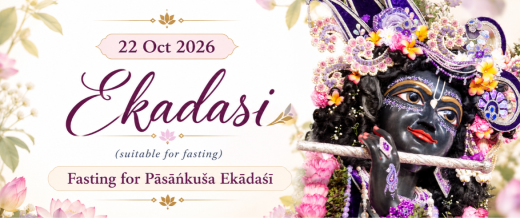
Kāmada Ekadashi | 29 March 2026 (Sunday)
Suitable for fasting
(Fasting for Kāmada Ekadashi)
Break fast on 30 March 2026 (Monday)
Time: 05:31 (sunrise) – 07:12 (end of tithi) LT
Please confirm with your local temple for exact breaking time.
Festival Event
Dāmanakāropaṇa Dvādaśī
Ekadashi Story
Sri Suta Goswami said, "Oh sages, let me offer my humble and respectful obeisances unto the Supreme Lord Hari, Bhagavan Sri Krishna, the son of Devaki and Vasudeva, by whose mercy I can describe the fast day that removes all kinds of sins.
It was to the devoted Yudhisthira that Lord Krishna glorified the twenty-four primary Ekadasis, which destroy sin, and now I shall recount one of those narrations to you.
Great-learned sages have selected these twenty-four narrations from the eighteen Puranas, for they are truly sublime.
Yudhishthira Maharaja said, 'Oh Lord Krishna, Oh Vasudeva, please accept my humble obeisances. Please describe to me the Ekadasi that occurs during the light part of the month of Chaitra [March-April].
What is its name, and what are its glories?'
Lord Sri Krishna replied, 'Oh Yudhishthira, please listen to Me attentively as I relate the ancient history of this sacred Ekadasi, a history Vasishtha Muni once related to King Dilipa, the great-grandfather of Lord Ramachandra.
King Dilipa asked the great sage Vasishtha, "Oh wise brahmana, I wish to hear about the Ekadasi that comes during the light part of the month of Chaitra.
Please describe it to me."
Vasishtha Muni replied, "Oh king, your inquiry is glories. Gladly shall I tell you what you wish to know. The Ekadasi that occurs during the light fortnight of Chaitra is named Kamada Ekadasi. It consumes all sins, as a forest fire consumes a supply of dry firewood. It is very purifying, and it bestows the highest merit upon one who faithfully observes it.
Oh king, now hear an ancient history which is so meritorious that it removes all one's sins simply by being heard. Once, long ago, there existed a city-state named Ratnapura, which was decorated with gold and jewels and in which sharp-fanged snakes would enjoy intoxication. King Pundarika was the ruler of this most beautiful kingdom, which numbered many Gandharvas, Kinnaras, and Apsaras among its citizens. Among the Gandharvas were Lalit and his wife Lalita, who was an especially lovely dancer. These two were intensely attracted to each other, and their home was full of great wealth and fine food.
Lalita loved her husband dearly, and likewise Lalit constantly thought of her within his heart.
Once, at the court of King Pundarika, many Gandharvas were dancing and Lalit was singing alone, without his wife. He could not help thinking about her as he sang, and because of this distraction he lost track of the song's meter and melody. Indeed, Lalit sang the ending of his song improperly, and one of the envious snakes who was in attendance at the king's court complained to the king that Lalit was absorbed in thinking of his wife instead of his sovereign. The king became furious upon hearing this, and his eyes turned crimson with rage.
Suddenly he shouted, 'Oh foolish knave, because you were lustfully thinking of a woman instead of reverently thinking of your king as you performed your court duties, I curse you to at once become a cannibal! Oh king, Lalit immediately became a fearful cannibal, a great man-eating demon whose appearance terrified everyone. His arms were eight miles long, his mouth was as big as a huge cave, his eyes were as awesome as the sun and moon, his nostrils resembled enormous pits in the earth, his neck was a veritable mountain, his hips were four miles wide, and his gigantic body stood a full sixty-four miles high. Thus poor Lalit, the loving Gandharva singer, had to suffer the reaction of his offense against King Pundarika.
Seeing her husband suffering as a horrible cannibal, Lalita became overwhelmed with grief. She thought, 'Now that my dear husband is suffering the effects of the kings' curse, what is to be my lot?
What should I do? Where should I go?'
In this way Lalita grieved day and night.
Instead of enjoying life as a Gandharvas wife, she had to wander everywhere in the thick jungle with her monstrous husband, who had fallen completely under the spell of the king's curse and was wholly engaged in terrible sinful activities.
He wandered fitfully across forbidding region, a once-beautiful Gandharva now reduced to the ghastly behaviour of a man-eater.
Utterly distraught to see her dear husband suffer so much in his dreadful condition, Lalita began to cry as she followed his mad journeying.
By good fortune, however, Lalita came upon the sage Shringi one day.
He was sitting on the peak of the famous Vindhyachala Hill.
Approaching him, she immediately offered the ascetic her respectful obeisances.
The sage noticed her bowing down before him and said, 'Oh most beautiful one, who are you?
Whose daughter are you, and why have you come here? Please tell me everything in truth.
Lalita replied, 'Oh great age, I am the daughter of the great Gandharva Viradhanva, and my name is Lalita.
I roam the forests and plains with my dear husband, whom King Pundarika has cursed to become a man-eating demon.
Oh brahmana, I am greatly aggrieved to see his ferocious form and terribly sinful activities.
Oh master, please tell me how I can perform some act of atonement on behalf of my husband.
What pious act can I perform to free him from this demonic form, Oh best of brahmanas?
'The sage replied, 'Oh heavenly maiden, there is an Ekadasi named Kamada that occurs in the light fortnight of the month of Chaitra.
It is coming up soon.
Whoever fasts on this day has all his desires fulfilled.
If you observe this Ekadasi fast according to its rules and regulations and give the merit you thus earn to your husband, he will be freed from the curse at once.'
Lalita was overjoyed to hear these words from the sage.
Lalita faithfully observed the fast of Kamada Ekadasi according to the instructions of the sage Shringi, and on Dvadasi she appeared before him and the Deity of Lord Vasudeva and said, 'I have faithfully observed the fast of Kamada Ekadasi.
By the merit earned through my observance of this fast, let my husband be free from the curse that has turned him into a demoniac cannibal.
May the merit I have gained thus free him from misery.'
As soon as Lalita finished speaking, her husband, who stood nearby, was at once freed from the king's curse.
He immediately regained his original form as the Gandharva Lalit, a handsome heavenly singer adorned with many beautiful ornaments.
Now, with his wife Lalita, he could enjoy even more opulence than before.
All this was accomplished by the power and glory of Kamada Ekadasi.
At last the Gandharva couple boarded a celestial airplane and ascended to heaven.
Lord Sri Krishna continued, 'Oh Yudhishthira, best of kings, anyone who hears this wonderful narration should certainly observe holy Kamada Ekadasi to the best of his ability, such great merit does it bestow upon the faithful devotee.
I have therefore described its glories to you for the benefit of all humanity.
There is no better Ekadasi than Kamada Ekadasi.
It can eradicate even the sin of killing a brhmana, and it also nullifies demoniac curses and cleanses the consciousness.
In all the three worlds, among movable and immovable living entities, there is no better day'
Ekadashi Seva with Mayapur.com
On this sacred day, devotees can offer seva to the Deities of Śrī Mayapur Dhām and receive Their divine blessings.
Your offerings support the daily worship and devotional services carried out in Śrīdhāma Mayapur — the spiritual capital of the world.
Take this opportunity to participate in Ekadashi Seva according to your capacity and receive the mercy of the Lord.
For Ekadashi seva:
https://www.mayapur.com/puja/nrsimhadev
The appearance day of Srivasa Thakur was observed in Mayapur with a full day of devotional activities including darshan, class, abhishek, kirtan, and a drama presentation in the evening.
Srivasa Thakur is one of the members of the Pancha Tattva, the five personalities who appeared with Chaitanya Mahaprabhu to spread the congregational chanting of the holy names. His home played a central role in the early pastimes of Lord Chaitanya. It was there that the Lord would hold nocturnal kirtans with His close associates, gatherings that became the beginning of the saṅkīrtana movement.
These kirtans were not open to everyone. Lord Chaitanya did not allow outsiders to enter because the intense spiritual emotions expressed during these gatherings—such as tears, loud crying, fainting, and other symptoms of ecstasy—could easily be misunderstood by those unfamiliar with devotional life. For this reason, the kirtans at Srivasa Thakur’s home were held as intimate assemblies of the Lord’s close associates.
The courtyard of his home, known today as Srivasa Angan, remains one of the most historically important places connected with these pastimes.
According to Gaudiya Vaishnava tradition, Srivasa Thakur is understood to be an incarnation of Narada Muni, the sage known throughout the Vedic literature for constantly glorifying the Lord and inspiring devotion wherever he travels. His younger brother, Ramai Pandit, is described as the incarnation of Parvata Muni, Narada’s close companion.
The morning program began with darshan of the Pancha Tattva, who were dressed in new garments offered for the occasion. The altar decorations followed a theme connected to the idea of transformation through divine association. It was such a sight to behold as the curtains sprang open, revealing such a divine sight, a sight only truly felt by the heart, not just seen by the eyes.
A narration explains the theme:
“As iron becomes gold by the touch of sparśa-maṇi (touchstone), so the body becomes renewed by the entrance of Narada-śakti. When a touchstone touches iron, the iron turns to gold. Parvata Muni once called Narada Muni a touchstone, because by his touch the hunter, who was the lowest among men, became elevated into a perfect Vaiṣṇava.”
In this way, the association of a pure devotee is compared to the touchstone that transforms iron into gold. Because Srivasa Pandit is described as the incarnation of Narada Muni, this idea of spiritual transformation became the inspiration for the decorations. Touchstone motifs were placed throughout the altar decorations, symbolizing how the presence of pure devotional energy can transform the heart.
After the divine darshan of Their Lordships, the program continued with an abhishek ceremony accompanied by bhajans and kirtan.
Within the courtyard of Srivasa Thakur’s house there was once a kalpa-vṛkṣa tree. Devotees would pick flowers from this tree for worship, and it is said that no matter how many flowers were picked, more would continue to appear. Devotees from different places would come there to collect flowers for the worship of the Lord.
In the teachings of Bhaktivinoda Thakur, Srivasa Thakur is also described within the Nāmahaṭṭa system as one of the assistant directors in Navadvipa, helping distribute the “commodity” of love of Krishna. In this description, the exchange is not based on money—the price is faith and devotion, śraddhā and bhakti.
The evening program concluded with a drama depicting the well-known pastime involving Chand Kazi. The performance presented the historical moment when Lord Chaitanya led a large kirtan procession through Navadvipa in response to the attempt to stop congregational chanting.
The day concluded with a special opportunity for everyone present. Devotees were invited to bathe the pandoka of Srivasa Thakur with sacred Ganga water, allowing each person to personally participate in honoring this great associate of Chaitanya Mahaprabhu.
At the same time, kirtan was taking place at Srivasa Angan, filling the area with the sound of the holy names as devotees gathered together in remembrance of Srivasa Thakur’s service to the saṅkīrtana movement.
It was a day filled with devotion, participation, and reflection, leaving many with a renewed appreciation for the opportunity to honor and remember such exalted personalities.
Hare Krishna Devotees!
Please accept our humble obeisances. All glories to Srila Prabhupada!
On Wednesday, March 11th, we will be celebrating Srivas Thakur’s appearance day. *Please join us at the temple on this special day for the program at 4pm.*
We welcome all the devotees to come hear the glories of Srivas Thakur and participate in the wonderful service of bathing Sri Chaitanya Mahaprabhu’s Padukas with Ganga jal in honour of the appearance day of Srivas Thakur, by whose mercy we can receive the shelter of Lord Krsna’s lotus feet.
All devotees are also welcomed to prepare and bring bhoga for the pleasure of our Lordships Sri Sri Pancatattva.
Please join us to celebrate Srivas Thakur with your friends and families for the mercy of Panchatattva!
We will have space blocked off for all the devotees so that everyone can gather comfortably and take part in the program.
We hope to see you there!
Your servants,
Pancha-tattva festival celebration team