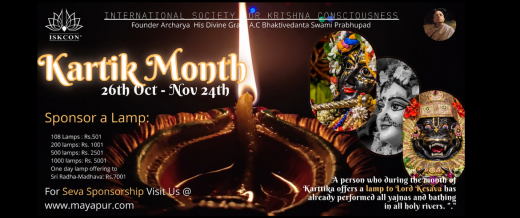
The Special Glories of Kartika Maas
By Sanatana Gosvami
Kartika month is the most important month in our calendar, as it is very dear to Sri Sri Radha-Madhava. Just as there is no yuga equal to Satya-yuga, no scripture equal to the Vedas, and no place of pilgrimage equal to the Ganges, so there is no month equal to Kartika. During the Kartika month, millions of devotees worship Damodara Krishna with ghee lamps and devotional bhajans, glorifying His playful childhood pastime of stealing yogurt. And traditionally, desiring to satisfy Their Lordships, Gaudiya Vaisnavas celebrate this month by following certain vows. Below we present these vows, observing which one can easily get a priceless treasure of the pure love of Sri Sri Radha-Madhava! Let us take the opportunity and accept this wonderful gift of the most merciful Karttika.
Kartika is particularly dear to Lord Krishna because it is the month of Srimati Radharani. Gaudiya Vaishnavas observe Kartika-vrata, also known as Damodar-vrata, Urjja-vrata, or niyama-seva-vrata, with the desire to please Srimati Radharani and receive Her mercy. The essence of this vow is to increase our devotional service to Sri Sri Radha-Damodara, offering Them our time, attention, prayers, and sincere efforts.
The name Urjja-vrata is especially significant. Urjjesvari is one of the names of Srimati Radharani, meaning “Mistress of Urjja-vrata.” The word urjjah means “wealth” or “power.” All wealth and strength manifest in Her for serving Sri Krishna. Thus, devotees attach great importance to Kartika, aspiring to satisfy Srimati Radharani and gain the opportunity to serve Her beloved Sri Krishna.
For Gaudiya Vaishnavas, Kartika-vrata is especially dedicated to the worship of Srimati Radharani and Her gopis, while also lovingly glorifying Lord Damodara, the Lord of Gokula. The month is a time to cultivate devotion, follow additional practices, and consciously dedicate ourselves to pleasing the Divine Couple.
Kartika is not only a month for offering lamps; it is also a special opportunity to hear the glories of the Lord and immerse ourselves in spiritual discussions. Hari-bhakti-vilasa and the Skanda Purana describe the extraordinary benefits of hearing Hari-katha during this month.
Hari-bhakti-vilasa, Sanatana Gosvami
Daily offering of ghee lamp to Radha-Damodara (any Radha-Krishna Deity or picture) and singing Damodarastakam is one of main seva that everyone could offer during Karttika month. One should also inspire as many souls as possible to offer lamps to Sri Radha- Damodara for their spiritual benefit. Hari Bhakti Vilasa states that the best place to perform Karttika vrata is at Sri Vrindavan dhama or other holy dhamas like Mayapur.
Skanda Purana, dialogue between Brahma and Narada
Moreover, for those who hear Visnu-katha in this month, each half verse or quarter of verse yields the fruits of donating one hundred cows; indeed, O great sage, all other duties should be given up in favor of hearing scriptures from holy men. Be it for spiritual benefit or with other expectations, by engaging in Hari-katha one uplifts hundreds of his family’s generations.
A person will burn all sinful reactions and gain the fruit of ten thousand sacrifices for each day of Kartika spent in the delight of the scriptures. In fact, Madhusudana is not as pleased by sacrifices or by charity of cows and elephants as He is pleased by discourses from the scriptures during Kartika.
O eminent sage, by hearing Hari-katha one can transcend the distress accumulated in millions of births. By regularly trying to read Srimad Bhagavatam during this month one gains the benefit of reading all eighteen Puranas. (75-81) Furthermore, during Kartika a man should cultivate supreme devotion by living among Vaisnavas, at the cost of giving up acts of piety and other prescribed duties. (82)
These instructions remind us to make space for hearing and reading during Kartika. Even if we cannot take up many additional services, we can try to read a little of Srimad-Bhagavatam each day, hear from devotees, sing devotional songs, and spend time in the association of Vaishnavas. Small, consistent efforts can help us remain connected to the purpose of this sacred month.
One of the most cherished practices during Kartika is offering a lamp to Lord Damodara. Each evening, devotees gather to offer lamps and sing Damodarastakam, remembering how the Supreme Lord lovingly allowed Mother Yashoda to bind Him with ropes.
The scriptures glorify this simple offering in extraordinary ways:
“When one offers a lamp during the month of Karttika, his sins in many thousands and millions of births perish in half an eye blink.”
“Please hear the glories of offering a lamp during pleasing to Lord Kesava. O King of brahmanas, a person who offers a lamp in this way will not take birth again in this world.”
“By offering a lamp during the month of Karttika one attains a pious result ten million times greater than the result obtained by bathing at Kuruksetra during a solar eclipse or by bathing in the river Narmada during a lunar eclipse.”
“O Tiger among sages! For a person who thus offers a lamp burning with ghee or sesame oil, what is the use of performing an asvasmedha-yajna?”
“Even if there are no mantras, no pious deeds, and no purity, everything becomes perfect when a person offers a lamp during the month of Karttika.”
“A person who during the month of Karttika offers a lamp to Lord Kesava has already performed all yajnas and bathing in all holy rivers.”
“A person who offers a lamp to Lord Krishna during Karttika attains the eternal spiritual world where there is no suffering.”
“O King of brahmanas, when someone offers Him a lamp on the full-moon day of the month of Karttika, Lord Krishna, finding that He does not have sufficient money to repay that gift, gives Himself in exchange for that lamp.”
“All the results acquired by donating grains during pitri-paksha or by distributing water in the hot months of Jyeshtha or Ashadha are easily gained in the course of Kartika merely by reviving (relighting) a dipa offered by someone else.”
The ancestors say: When someone in our family pleases Lord Kesava by offering to Him a lamp during the month of Karttika, then, by the mercy of the Lord who holds the Sudarsana-cakra in His Hand, we will all attain liberation.
“O Narada, no sin exists anywhere in the three worlds that will not be purified by offering a lamp to Lord Kesava during Karttika.”
The glories of lamp offering are further expressed in the following verse:
kim ca meru-mandara-matrani
kritva papany aseshatah
dahate natra sandeho
dipa-danat tu karttike
By offering a lamp during the month of Kartika, one burns away a collection of sins as vast as Mount Meru or Mount Mandara. Of this, there is no doubt.
These verses remind us not to underestimate the offering of a single lamp. We may not always be able to perform elaborate worship or extensive austerities, but we can approach the Lord with a simple offering and a sincere prayer. Kartika gives us the opportunity to make this offering a daily part of our devotional lives.
Kartika is also known as the month of niyama-seva. Niyama means “rules”—additional prayers, pujas, reading, preaching, and extra service to Lord Hari, the Spiritual Master, and the Vaishnavas. The vow encourages us to dedicate this time to a more attentive and purposeful devotional routine.
The following observances are described in the material from Hari-bhakti-vilasa and the Skanda Purana:
Rise at brahma-muhurta and attend mangala-aratika – attain spiritual world.
Offer incense, ghee lamp, flowers (malati, lotus, rose, jasmine, lily) and camphor lamp three times a day.
Daily ghee lamp to Radha-Damodara (any Radha-Krishna Deity or picture) and sing Damodarastakam.
Maintain akhanda ghee/sesame lamp before Deity, base of Tulasi, hang in the sky – attain the spiritual world. Just by offering a ghee lamp to Sri Krishna, one attains perfection and goes back to Godhead.
Offer sweet rice mixed with ghee, tasty food and varieties of fruits.
Mandira-parikrama four times daily while reciting prayers – get the merit of a horse sacrifice with every step.
Offer water and prasada to ancestors.
Offer camphor lamp with aguru oil esp. on Ekadasi – no rebirth.
Offer fresh flower garlands (rose or lotus) and sanadalwood paste.
Offer new clothes.
Offer one lakh of Tulasi leaves to Krishna.
Daily offer incense, ghee lamp and flowers to Tulasi and circumambulate her.
Relight another person’s ghee lamp – attain unlimited merit and not see Yamaraja.
Offer water to the moon.
Offer floating ghee lamp.
Enthusiastically dance, sing and play musical instruments, and recite prayers before the Deity – attain spiritual world with your ancestors.
These observances offer different ways to deepen our service, but each devotee should consider what can be followed sincerely according to their capacity and circumstances. The purpose is not to become overwhelmed by a long list of practices, but to use Kartika as an opportunity to become more attentive in our relationship with Krishna, Srimati Radharani, our spiritual master, and the Vaishnavas.
The last five days of Kartika are known as Bhishma-Pancaka, during which Vaishnavas also follow specific vows. Kartika-vrata is considered one of the main engagements for Vaishnavas, and the Caturmasya-vrata is considered complete only when its final month, Urjja-vrata, is observed.
We do not need to wait until we can perform something extraordinary to begin serving. We can start with what is within our reach: offering a lamp to Sri Sri Radha-Damodara, singing Damodarastakam, reading Srimad-Bhagavatam, chanting the holy names with attention, serving Tulasi Devi, or helping someone else engage in devotional service.
The mercy of Kartika invites us to make these efforts with sincerity and to remember that the purpose of every vow is to please the Lord. May this sacred month inspire us to offer more of our hearts to Sri Sri Radha-Damodara and to grow in our desire to serve Them.
As we light our lamps each evening, may we also remember those who would like to make this offering but may not have the opportunity to do so. By supporting Lamp Seva, we can help more devotees offer lamps to Sri Damodara during this auspicious month and share in the joy of serving the Lord.
May our offerings, however simple, be made with love. May Sri Sri Radha-Damodara be pleased with our sincere endeavours, and may we receive the mercy to continue serving Them with greater devotion.
For opportunities to engage in Kartik Seva, please visit: https://www.mayapur.com/festivals/Kartik
Hare Krishna!
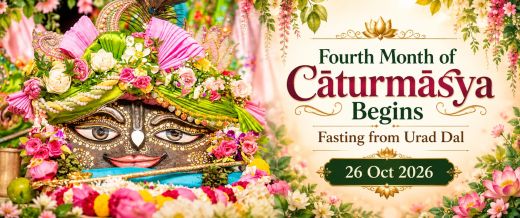
The sacred month of Kārtika, also known as Dāmodara Māsa, marks the beginning of the fourth and final month of Cāturmāsya. Beginning on 26 October 2026, this auspicious period invites devotees to deepen their devotion to Lord Śrī Kṛṣṇa through sincere prayer, spiritual discipline, and loving service.
Cāturmāsya is a sacred four-month period dedicated to cultivating self-control, simplifying our lives, and increasing our remembrance of the Supreme Lord. Śrīla Prabhupāda explains in his purport to Śrī Caitanya-caritāmṛta, Madhya-līlā 4.169, that the purpose of observing these vows is to reduce sense gratification and advance in devotional service.
This beautiful pastime reveals the extraordinary sweetness of the Lord. He is conquered not by wealth, scholarship, or strength, but by sincere love and devotion.
During this month, devotees lovingly worship Lord Dāmodara, offer ghee lamps, sing the Śrī Dāmodarāṣṭakam, chant the holy names, and hear the transcendental pastimes of the Lord. Even a simple offering, made with a sincere heart, becomes a beautiful expression of love for Kṛṣṇa.
These practices are not merely external austerities. Their true purpose is to purify the heart and awaken our natural love for the Lord. Every restraint becomes meaningful when undertaken for Kṛṣṇa’s pleasure, and every act of service becomes an opportunity to remember His boundless mercy.
As we enter this sacred month, let us renew our commitment to devotional life. Let our homes resound with the chanting of the Hare Kṛṣṇa mahā-mantra, let our hands offer lamps to Lord Dāmodara, and let our hearts become filled with gratitude for His causeless mercy.
May this auspicious month inspire us to move beyond the distractions of material life and take shelter in the loving service of Śrī Śrī Rādhā-Dāmodara.
This Kārtika, let us offer not only a lamp to the Lord, but also the light of our hearts in loving surrender at His lotus feet.
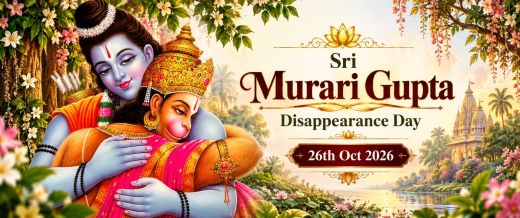
Among the intimate associates of Śrī Chaitanya Mahāprabhu, Śrī Murāri Gupta holds a special place as an embodiment of humility, compassion, and unwavering devotion. A physician by profession and a treasure house of love of God, he dedicated his life to serving the Lord and His devotees. In the Gauḍīya Vaiṣṇava tradition, he is revered as the incarnation of Śrī Hanumān, the eternal servant of Lord Śrī Rāmacandra.
According to Gaura-gaṇoddeśa-dīpikā (91):
murāri-gupto hanumān
aṅgadaḥ śrī-purandaraḥ
yaḥ śrī-sugrīva-nāmāsīd
govindānanda eva saḥ
This verse reveals that Murāri Gupta was Hanumān in Lord Rāmacandra’s pastimes, Purandara was Aṅgada, and Govindānanda was Sugrīva. Just as Hanumān’s heart was eternally absorbed in the service of Lord Rāma, Murāri Gupta’s life exemplified unshakable devotion to his beloved Lord.
Born into a family of Ayurvedic physicians in Śrīhaṭṭa (Sylhet), Murāri Gupta later moved to Navadvīpa, where he became a close companion of the young Nimāi Paṇḍita. They studied together under Gaṅgādāsa Paṇḍita, engaging in discussions and scholarly debates. Even during these childhood pastimes, Murāri Gupta witnessed Mahāprabhu’s extraordinary intelligence and spiritual potency. His very name carries a beautiful significance: gupta means “hidden,” indicating that Śrī Murāri, the Lord Himself, resided secretly within his heart.
Śrīla Kṛṣṇadāsa Kavirāja Gosvāmī glorifies him in Śrī Caitanya-caritāmṛta (Ādi-līlā 10.49), describing Murāri Gupta as the twenty-first branch of the tree of Śrī Chaitanya Mahāprabhu and a treasure house of love of Godhead, whose humility melted the Lord’s heart. His compassion extended beyond bodily healing. As a physician, he treated physical ailments, while his devotion and association helped others overcome the deeper disease of material existence. As stated in Śrī Caitanya-caritāmṛta (Ādi-līlā 10.51), he relieved both bodily and spiritual suffering.
One of the most celebrated episodes of his life reveals the depth of his devotion to Lord Rāmacandra. Mahāprabhu once encouraged him to worship Lord Śrī Kṛṣṇa. Although Murāri Gupta deeply respected the Lord’s instruction, he could not bear the thought of abandoning his beloved Rāma. Overwhelmed with anguish, he surrendered at Mahāprabhu’s lotus feet, expressing his inability to give up his eternal Lord. Mahāprabhu was profoundly pleased by this steadfastness and glorified his unflinching devotion. This beautiful pastime, described in Śrī Caitanya-caritāmṛta (Madhya-līlā 15.137–157), teaches that pure devotion is rooted in eternal, loving service to one’s worshipable Lord.
Murāri Gupta also made an invaluable contribution to the Gauḍīya Vaiṣṇava tradition by composing Śrī Kṛṣṇa-Caitanya-caritāmṛta, a Sanskrit account of Mahāprabhu’s life and pastimes. His writings preserve precious memories of the Lord’s early activities and remain an important source for understanding the history of the Gauḍīya Vaiṣṇava movement.
On the sacred occasion of his disappearance day, we remember Śrī Murāri Gupta’s humility, compassion, and unwavering love for Lord Rāmacandra. His life reminds us that genuine devotion is expressed through steadfast faith, selfless service, and complete surrender to the Lord.
May we pray for the mercy of Śrī Murāri Gupta, that our hearts may become filled with pure devotion and that, like Śrī Hanumān, we may dedicate every moment of our lives to the loving service of the Lord.
bhagavan api ta ratrih
saradotphulla-mallikah
viksy- a rantum manas cakre
yoga-mayam upasritah
Sri Kṛṣṇa is the Supreme Personality of Godhead, full in all opulences, yet upon seeing those autumn nights scented with blossoming jasmine flowers, He turned His mind toward loving affairs. To fulfill His purposes He employed His internal potency. — Śrīmad-Bhāgavatam 10.29.1
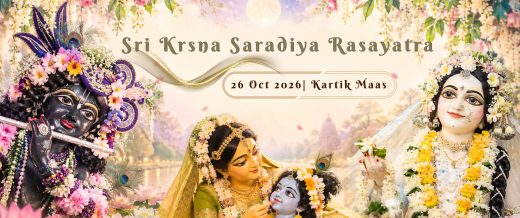
On the full moon night of Kārtika, the forests of Vṛndāvana are remembered as the setting for one of the most enchanting pastimes of Lord Śrī Kṛṣṇa: the Rāsa-līlā. Beneath the autumn moon, amid the fragrance of blossoming jasmine and the gentle sounds of the forest, Śyāmasundara plays His flute, awakening the hearts of His beloved gopīs and inviting them into His transcendental dance. This pastime reveals the extraordinary sweetness of the Lord and the loving exchanges He shares with His devotees.
In Śrīdhāma Māyāpur, which is deeply connected with the spiritual atmosphere of Vṛndāvana, Śrī Kṛṣṇa Rāsayātrā is celebrated with beautiful offerings and devotional festivities. On this auspicious occasion, the dancing Deities of Śrīmatī Rādhārāṇī and the Aṣṭa-sakhīs, each accompanied by their own Śrī Mādhava, are beautifully arranged on the platform below the altar of Śrī Śrī Rādhā-Mādhava. Devotees prepare sweet rice and a variety of milk sweets as offerings for Their Lordships, seeking to please Them on this sacred evening.
Rāsa Pūrṇimā also marks the beginning of Śrī Śrī Rādhā-Mādhava’s weekly elephant processions in Māyāpur. On this special evening, Their Lordships come out of the temple and travel around the Māyāpur campus on the back of an elephant, accompanied by Śrī Śrī Gaura-Nitāi from Śrīla Prabhupāda’s Bhajana-kuṭīra. A harināma party leads the procession with ecstatic kīrtana, filling the atmosphere with the chanting of the holy names.
As Their Lordships proceed through the campus, the sounds of conch shells and vibrant drums announce Their arrival. The boys of the Māyāpur Gurukula chant auspicious mantras, while the pathways glow with the light of lamps and the campus shines with festive illumination. Devotees create intricate raṅgolīs along the procession route, using colourful powders, flowers, and other natural materials to transform the surroundings into offerings of beauty and devotion. The community also prepares a variety of dishes for the pleasure of the Lord.
The evening continues with devotees offering lamps to Their Lordships, followed by the singing of Dāmodarāṣṭakam and the Gopī-gīta. Through these offerings, prayers, and the collective chanting of the holy names, the devotees express their desire to serve and please Śrī Śrī Rādhā-Mādhava.
The full moon of Dāmodara month is also known as the second full moon of the autumn season, when Rāsa-līlā is celebrated again. This second Rāsa-yātrā is observed especially in Bengal, while the first is celebrated more prominently in Śrīdhāma Vṛndāvana. In Māyāpur, the occasion brings together worship, music, dance, kīrtana, lamps, and beautiful offerings, allowing devotees to remember the transcendental pastimes of the Divine Couple.
As Śrīla Prabhupāda explains:
“By gradual development of transcendental knowledge, one can rise to the stage of the transcendental arts of music and dance displayed by the Lord in His rasa-lila. But without having the Vedic knowledge one can hardly understand the transcendental nature of the Lord's rasa dance and music.” — Śrīla Prabhupāda, Śrīmad-Bhāgavatam 2.2.4
The Rāsa-līlā is not an ordinary dance, but a transcendental pastime of the Supreme Lord, whose activities are understood through spiritual knowledge and devotion. By the mercy of Śrī Caitanya Mahāprabhu and Śrīla Prabhupāda, devotees are given the opportunity to hear about Kṛṣṇa’s pastimes in the proper devotional understanding and gradually appreciate their sweetness.
Ultimately, Śrī Kṛṣṇa Rāsayātrā is an opportunity to turn our hearts towards the pleasure of the Lord. Through the procession, kīrtana, lamp offerings, and loving service, the devotees seek not their own enjoyment, but the pleasure of Śrī Śrī Rādhā-Mādhava. This is the essence of the festival: to remember the Lord’s transcendental pastimes and engage whatever we have in His service.