In Memory of Two Great Vaishnava Acharyas
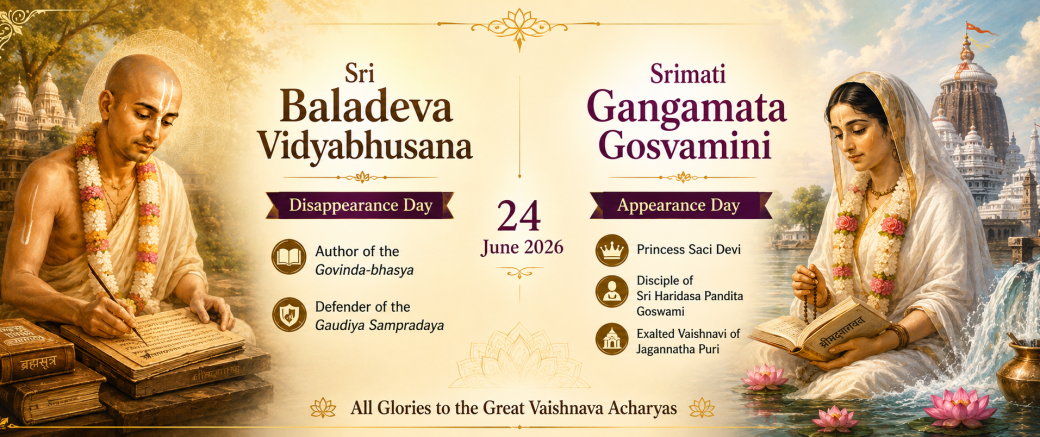
Sri Baladeva Vidyabhusana: The Ornament of Knowledge
Sri Baladeva Vidyabhusana is one of the most celebrated acharyas in the Gaudiya Vaishnava tradition. Renowned for his profound scholarship, deep devotion, and unwavering dedication to the teachings of Sri Caitanya Mahaprabhu, he played a crucial role in preserving and establishing the philosophical foundations of Gaudiya Vaishnavism.
Very little is known about his birth and family background, as he never spoke about his personal life. Historians believe he was born in the early eighteenth century near Remuna in Orissa (present-day Odisha, India). From a young age, he displayed extraordinary intelligence and mastered grammar, poetry, rhetoric, logic, and the Vedic scriptures.
During his travels across India, he studied the teachings of Madhvacharya and became well-versed in Tattvavada philosophy. His life took a significant turn when he met Sri Radha-Damodara Deva, a disciple in the line of Sri Rasikananda Deva. Inspired by the teachings of Gaudiya Vaishnavism, he accepted initiation and later moved to Vrindavana, where he studied under the renowned Gaudiya scholar Sri Visvanatha Cakravarti Thakura.
Sri Baladeva Vidyabhusana is best remembered for defending the Gaudiya Vaishnava sampradaya during the famous Jaipur controversy. When scholars challenged the legitimacy of the Gaudiya tradition due to the absence of a commentary on the Vedanta-sutra, Baladeva composed the celebrated *Govinda-bhasya*, a masterful commentary that firmly established the philosophical standing of Gaudiya Vaishnavism. In recognition of this extraordinary achievement, he was awarded the title **"Vidyabhusana,"** meaning "Ornament of Knowledge."
In addition to the *Govinda-bhasya*, he authored many important works, including *Prameya-ratnavali*, *Siddhanta-ratna*, and commentaries on key Vaishnava scriptures. His writings continue to guide devotees and scholars to this day.
Sri Baladeva Vidyabhusana spent his life serving his spiritual masters, preserving the teachings of the previous acharyas, and glorifying Sri Sri Radha-Krishna. Although the exact date of his birth is unknown, his disappearance is traditionally commemorated by devotees as a sacred occasion to remember his immense contributions to the Gaudiya Vaishnava tradition.
His legacy lives on through his writings, his example of humility and scholarship, and the enduring strength of the Gaudiya sampradaya that he so expertly defended.
Srimati Gangamata Gosvamini: The Princess Who Became a Saint
Srimati Gangamata Gosvamini is revered as one of the most extraordinary female acharyas in the Gaudiya Vaishnava tradition. Renowned for her deep devotion, scriptural wisdom, and complete dedication to the service of Sri Sri Radha-Krishna, her life continues to inspire devotees centuries after her appearance.
Born as **Princess Saci Devi**, she was the daughter of **King Naresh Narayana of Bengal**. Although raised amidst royal wealth and privilege, she showed little attraction to material comforts from an early age. Instead, her heart was drawn toward spiritual life, devotional practices, and the worship of Lord Krishna.
Following the departure of her parents, Saci Devi renounced her royal inheritance and journeyed to **Vrindavan**, seeking shelter among the Vaishnavas and dedicating herself fully to spiritual advancement. There she accepted **Sri Haridasa Pandita Goswami** as her spiritual master and immersed herself in the study of sacred scriptures, devotional service, and deep meditation upon Radha and Krishna.
Recognizing her sincerity and spiritual qualifications, her guru later instructed her to reside in **Jagannath Puri**. There she became associated with the historic **Radha-Kanai Temple**, helping restore its worship and establishing it as a center of devotional practice. Her profound teachings on the **Srimad-Bhagavatam** attracted many devotees, scholars, and respected leaders who came to hear her realizations.
She became widely known as **Gangamata Gosvamini** following a celebrated pastime connected with the sacred River Ganga. According to Gaudiya Vaishnava tradition, Mother Ganga personally bestowed her blessings upon the saint, and devotees thereafter honored her with the title "Gangamata," meaning "Mother Ganga."
Gangamata Gosvamini demonstrated through her life that devotion transcends wealth, social status, and worldly position. Her example of humility, renunciation, unwavering faith, and dedication to guru and Krishna remains a guiding light for practitioners of bhakti.
Although the exact date of her departure from this world is not historically certain, devotees annually observe her appearance and disappearance days to remember her extraordinary devotion and pray for her blessings in the path of pure devotional service.
Posted 2 months ago