Śrī Rāmacandra Vijayotsava
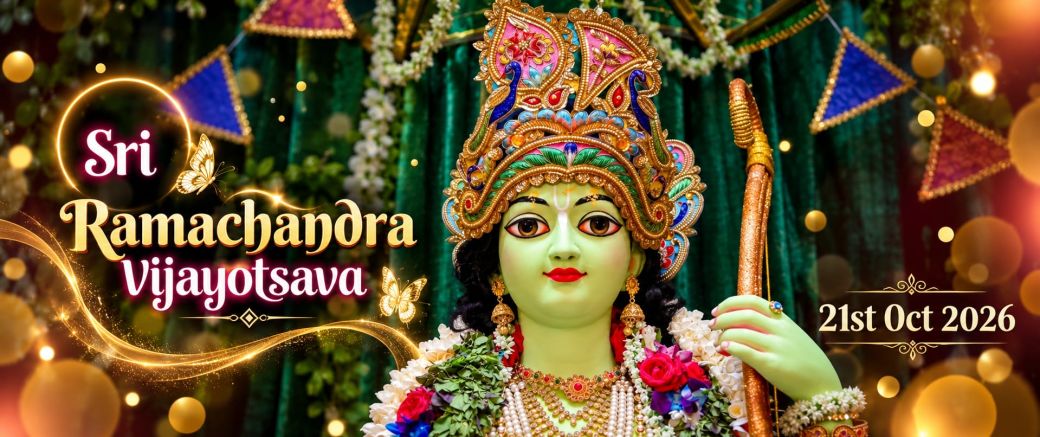
Śrī Rāmacandra Vijayotsava, celebrated on Vijayā Daśamī, commemorates the glorious victory of Lord Śrī Rāmacandra, the Supreme Personality of Godhead, over the powerful demon king Rāvaṇa. This sacred occasion reminds us that dharma triumphs over injustice, truth over falsehood, and devotion over pride.
Lord Rāmacandra appeared in the dynasty of King Ikṣvāku as the ideal king, son, husband, brother, and protector of His devotees. His life, beautifully narrated in the Rāmāyaṇa, teaches us how to remain steadfast in dharma even in the most difficult circumstances.
Although destined to become the king of Ayodhyā, Lord Rāma willingly accepted fourteen years of exile to honour His father, Mahārāja Daśaratha. Accompanied by Sītā-devī and Lakṣmaṇa, He entered the forest without resentment, demonstrating the highest standard of truthfulness and duty.
During Their exile, Sītā-devī was abducted by Rāvaṇa, the powerful ruler of Laṅkā. Lord Rāma then began His search for Her, accepting the loving service of Śrī Hanumān, Sugrīva, and the vāṇara army.
Hanumān's extraordinary devotion became a shining example of selfless service. Crossing the ocean and entering Laṅkā, he found Sītā-devī and delivered Lord Rāma's message to Her.
With the help of the vāṇaras, Lord Rāma's army crossed the ocean and reached Laṅkā. A great battle followed. Despite Rāvaṇa's immense power, wealth, and formidable army, his pride and unrighteousness ultimately brought about his downfall.
Finally, Lord Rāmacandra released His divine arrow and Rāvaṇa was defeated. Thus, righteousness was restored, and the Lord's victory became a timeless celebration of the triumph of good over evil.
Rāvaṇa represents the darkness that can arise within the heart—lust, pride, greed, anger, and the desire for control. Although he possessed great knowledge, wealth, and strength, he lacked humility and devotion.
Lord Rāma teaches us that true strength lies not in material power, but in truth, surrender, service, and devotion to the Supreme Lord.
For devotees, Vijayā Daśamī is therefore also a time for inner reflection:
Where there is pride, may humility arise.
Where there is anger, may compassion arise.
Where there is selfish desire, may the desire to serve arise.
Where there is forgetfulness of the Lord, may remembrance arise.
The greatest victory is not merely the defeat of an external enemy. It is the victory of the Lord's remembrance over the darkness within our own hearts.
After rescuing Sītā-devī and completing His exile, Lord Rāmacandra returned to Ayodhyā, where the citizens joyfully welcomed their beloved Lord. His reign became celebrated as Rāma-rājya, an ideal of righteous and compassionate governance.
His example continues to inspire us to live with integrity, responsibility, compassion, and devotion.
On this auspicious occasion, let us pray to Lord Rāmacandra for the strength to follow the path of dharma, the humility to serve, and the devotion to remember Him in all circumstances.
May the victory of Lord Rāmacandra become a victory within our own hearts.
Śrī Rāmacandra Bhagavān kī jaya!
Śrī Sītā-Rāma kī jaya!
Śrī Hanumān-jī kī jaya!
Posted 22 hours ago