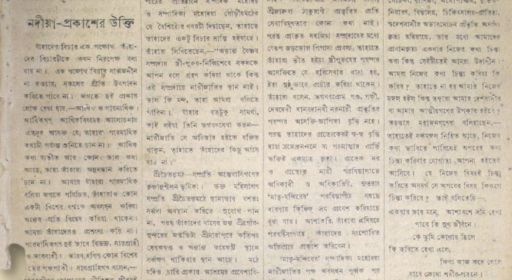
Our Guru Mahārāja, Bhaktisiddhānta Sarasvatī Gosvāmī, he was publishing one small paper, Dainika Nadiya Prakash, in Bengali. And if a brahmacārī would go and sell a few copies, he would be very, very glad. He would be very, very glad. And similarly, he advised me also that “If you get some money, publish book.” And he used to say that “This press propaganda, the publication propaganda, is bṛhad-mṛdaṅga.” So just to satisfy him we are trying to publish this Śrīmad-Bhāgavatam, Bhagavad-gītā, Bhakti-rasāmṛta-sindhu, Caitanya-caritāmṛta—very, very authoritative books—in English. And by the grace of Kṛṣṇa, it is unique in the history that religious book can be sold forty lakhs of rupees per month. It is record-breaking. There is no such instance.
(750424 – Lecture SB 01.07.07 – Vrndavana)
My Guru Mahārāja was questioned by one big politician. He came to see him. So my Guru Mahārāja . . . he was asking, “What are your activities?” So at that time he was publishing one paper. I think it is still published in Māyāpur. It is called . . . what is called? Dainika? Daily news, it was a daily newspaper, small. Navadvīpa Prakash, like that. Nadiya Prakash. Nadiya Prakash. So daily. So this politician inquired from Guru Mahārāja, “You are publishing a daily paper about God consciousness?” “Yes.” “No, what you are writing?” He was surprised. The politicians think that newspaper can be filled up with rubbish political news only. That’s all. They cannot think that newspaper can be filled up by news from spiritual world. Yes. They have no idea. They have no idea there is spiritual world.
So my Guru Mahārāja explained that, “Why you are thinking of only one small newspaper? You do not know what is spiritual world. This material world is one-fourth portion of the whole creation of the Lord. And the three-fourth portion is the spiritual world. And in this one-fourth portion there are innumerable universes. And in one of the universe . . . this is one of the universe. And in each universe there are millions of planets. And this planet, earthly planets, is only a small planet in that universe. And on this earthly planet, there are so many cities. And in each city, there are so many newspapers. And each newspaper has got so many editions. This is the position of the material world. Now, think over the spiritual world. It is...
The spiritual world is three-fourth, three times bigger than this material . . . and there are so many planets, so many universes, and so many activities. So we can produce not one newspaper daily, but every minute a newspaper. We can produce. Unfortunately, there is no customer. You see? This is the difficulty. For material news, there are so many customers, but when we put something spiritual news, no customer. This is the difficulty. Otherwise . . . you are thinking of one newspaper daily. We can issue every second a newspaper about spiritual news.”
(731225 – Lecture SB 01.15.47-48 – Los Angeles)
My Guru Mahārāja was publishing one paper, Dainika Nadiya Prakash. It was worth two paisa or one paisa. So if a brahmacārī could sell a few copies, he would have been so glad. You see? The collection was not even four annas. Still, he was so glad that “Oh, you have distributed so much.” Our business is to carry out the order, not to see success. Success is not so easy. That is not so easy.
(750520 – Morning Walk – Melbourne)
Information – Srila Bhaktisiddhanta Saraswati Thakura Prabhupada started ‘The Daily Nadiya Prakash’ daily newspaper in 1928 which ran for over 20 years till 1947. It announced itself as ‘viśve ekmātra dainik pāramarthik patra’ (the only daily spiritual newspaper in the world). Each issue typically consisted of eight pages. The front and back page provided current news of Nadia district in Bengal as well as that of India and the rest of the world. The middle pages contained spiritual teachings from the shastras and Acharyas’ writings. Dainik Nadiyā Prakāśa published both secular news, and commentary on contemporary events through the lens of devotional Hindu literatures of the Bengali Vaiṣṇava tradition in the early twentieth century.